Sunday, November 22, 2009

Blog Post 19

During class on Thursday, November 19, I didn’t really understand what was going on at the time. We all sat there is silence for most of the class period, and couldn’t comprehend why until we were left alone and the first video with voice appeared. This was the video of John Cage talking about silence, and how each one of his performances is different. Never the same. The performative aspect of Thursday’s class session changes the perspectives we have on a “normal” class session just by changing what the students and the teacher take part in. On any regular day, my classes consist of the students sitting in silence, for the most part, while the teacher explains the necessary materials for that specific class session. It was an interesting turn to not be spoken to, or lectured, during class but to simply just listen to the faint sounds.

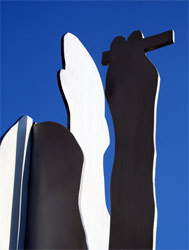
This is also the type of experience I gained from examining my sculpture outside, and by myself. It was silent, except for the activity occurring in the background of others talking, walking, coughing, etc. When approaching these sculptures outside, we are obviously asked to look at them in a different way than if they were inside. For my sculpture specifically, it was made to be outside; makes more sense outside. Story, is of a man who is smoking a cigarette and casually sitting and “talking”. Because this sculpture is “smoking”, and also on campus, being outside with nature is really the only place to be. Smoking is not allowed indoors while on campus, so it appears more realistic when set out of the museum itself.

Material also plays a big part in determining if a piece should be placed outside. Story is made of purely aluminum, which does not rust and is very sturdy. When we look at sculptures outside versus inside, we see them as a part of nature. Inside sculptures are looked at to be more fragile and/or delicate, and not to be touched. Story fits outside because it is casual and taking an appearance of a man himself. Freedom to be where he wants.

Monday, November 16, 2009

Blog Post 18: cursory analysis for WP3

William King's sculpture, Story, is of a 12-foot tall man smoking a cigarette. "Smoking my last cigarette and yakking away. I'm talking about giving up smoking, " says King. The sculpture is a representation of King himself who smoked a pack a day until 1971. This sculpture was made in 1970, so perhaps this was a marker of a soon-to-be accomplishment. William King is a contemporary American sculptor, born in 1925. His work mostly focuses on the human figure and can be seen in various states throughout the country. During the years of 1994 to 1998, he served as the president of the National Academy of Design (Wikipedia). In 2007, King was the recipient of the Lifetime Achievement in Contemporary Sculpture Award given by the International Sculpture Center (Wikipedia).

The sculpture is made only from aluminum and is put together like cardboard cut-outs would be. I think that the choice of using aluminum for this piece, and how the sculpture is put together, uses shading to help illustrate the various body parts. Looking at this piece I first noticed the giant leg coming out from the body itself. There is only one leg on this sculpture, and it is inserted into a slotted area through the midsection of the figure. There are two arms present and one of them is also in a slotted area like the leg. The arm which is placed in the slot is also the one which posesses the man's cigarette. As for the other arm, it is connected to the main body and is not as detailed as the other. The attached arm's hand does not contain fingers, but more of a ball-like fist instead.

The appearance of the body seems to be well defined and curvy with detail. It is easy to point out where the kneecap, ears, and other various joints are located. The arms and leg all have a bend to them, taking on a more human like form instead of a stiff one. However, they do seem to be a a little unproportional to the rest of the body. This definitly calls more attention to these specific parts. I think that this sculpture is trying to focus more on movement than anything else. The rest of the body is sort of left to a blank. We do not know what the man looks like, except from looking at a picture of the author himself, becasue there are no facial features except for his ears. No mouth, nose, eyes, or bone structure. I think that the sculpture gives off a vibe of freedom and self independence. The man is very laid back looking and holds his cigarette knowing it is his last. He makes his own choices.


Works Cited
Wikipedia. (2008, November 3). William King (artist). Retrieved November 17, 2009, from Wikipedia: http://en.wikipedia.org/wiki/William_King_(artist)

Blog Post 17: Experience with Art Objects

My experience with art objects does not really consist in a wide range of variety. I have really only been exposed to making a few art pieces in my elementary years and seeing additional pieces in museums (i.e. Joslyn Art Museum). My mom used to take me to a lot of museums when I was younger becuase it was really something that she seemed to enjoy. I didn't really like going to the art museums all the time, probably because it was something I couldn't really understand that much. I would become bored quickly and start to complain, just like a typical child would.

As I got older though, I actually developed an interest in looking at the different types of art. I wanted to stand there and depict the pieces of art instead of just walking around quickly so we could get done faster. Today, I enjoy going to art museums and looking at the variety. I find it interesting to know what the author of the piece is trying to say, and what they want the viewer to feel while they are looking at it. My main interests in art objects are life based, but I do also like some more abstract pieces too. I like to view life based art because I think it is more personal from the author, and gives the viewers some sense of their personalities and emotions.

I have also always liked to engage in making art. Most of the sculptures or paintings I have ever made were from my elementary days, when we had art class. This was probably my favorite class because we just got to use our imaginations and create something that wasn’t wrong. The only art that I have probably made in the last few years are some dycro glass pieces in the kiln. My mom likes to make art from glass so it’s always more available to me and encouraged.

Sunday, November 8, 2009

WP2 - Final Draft

Authors Note:

In the process of writing this specific essay, my main challenges were to find the right information to use about my comic. I struggled at first in trying to manage what I should and should not use to explain my comic and the argument that I developed from it. I thought that my argument might have been too broad, but then I realized that this was the point. In order to approach looking at this comic, one has to pick out the meaning. My meaning to this comic was that the unreal is made into a real environment, and this must be done with a series of events to gain the full perspective.

I made a series of changes and corrections into my essay from reading the peer reviews provided, and fixed only what I thought was necessary in improving the developmental meaning of the comic and the argument. In the introduction, I changed the tenth sentence from, “The snowman comic contains a variety of unreal activities, but also captures some real events that the audience is able to connect with, which is where my argument is made” to “The snowman comic contains a variety of unreal activities, but also captures some real events that the audience is able to connect with, which is what I want the audience to specifically notice from my argument.” I also added the sentence “Real events taking place in an unreal environment” so the audience could develop a better understanding of what my argument was made to be.

In the second paragraph after the fifth sentence, I added the sentence, “My reasons for the assumption being male is because the rabbit is taking on a more masculine look versus feminine, and men are looked at in having a higher rate in violence than women” because of a suggestion made to me by a peer review asking that I explain why I though the rabbit in the comic was male. I also added the term anthropomorphism, instead of saying ‘human characteristics’ as well.

In the fifth paragraph after the seventh sentence, I added, “The female snowman has a sort of frown on her face, as well as the male snowman too. However, what really makes their facial emotions differ are the eyebrows. The male snowman has angry looking eyes unlike the female who has raised eye brows full of fear”. This was also a suggestion from a peer to develop a better sense as to what the snowmen facial expressions had to offer in providing emotion. The tenth sentence was also added to the essay to describe body functions and movements the rabbit makes to enforce his being serious.

In the conclusion, the sentence, “Gender roles, secrets, and fearful events all occur in everyday life which is why I wanted to point out a variety of descriptions that make this comic so real in an unreal setting” was also added to develop more of a closing statement to my argument. I had also reorganized my works cited into alphabetical order.


This comic was made by Dan Piraro who is a cartoonist that had begun creating illustrations as a child. In 1981, Piraro started illustrating advertisements for Neiman-Marcus and he was then later able to become a full-time cartoonist around the year 1990. In 1995, He began his first book tour which was all reader supported ( Wikipedia). You can find Piraro’s comics, illustrated in many different books by the name of Bizarro. Most of his work possesses a higher level of abstract, cartoon characters which is unlike the comic I have chosen. Piraro generally likes to use both humans and animals in his illustrations, and they are most always given human characteristics. I chose this specific piece because of its more realistic features, yet you still know it is a cartooned image. This comic also strays from what Piraro’s comics usually possess because the characters are neither human nor animal (except for the rabbit of course). I find that for this specific comic, problem- solution arrangements best fits these overall meanings. The snowman comic contains a variety of unreal activities, but also captures some real events that the audience is able to connect with, which is what I want the audience to specifically notice from my argument. When looking at comics, we see them as just a cartoon but the idea had to come from somewhere right? Real events taking place in an unreal environment.

First off, while looking at this comic we notice the basics (i.e., characters, setting, mood, etc.). There are two snowmen present, as well as a rabbit. The snowmen themselves take on the traits of what a generic snowman should look like, but they also are engaging in anthropomorphism. The snowman on the left we know is female and the snowman on the right is male. The rabbit could be either sexes, male or female, but for the typical outlook on society I am guessing male would suit this rabbit more. My reasons for the assumption being male is because the rabbit is taking on a more masculine look versus feminine, and men are looked at in having a higher rate in violence than women. It is also simple to point out that the rabbit is definitely the “bad” guys and the snowmen are the “good” guys. We know that all three of these characters hold human qualities because they can control their bodies and are defending themselves when put into danger.

The two snowmen are held up by this rabbit and the male stands to defend himself with a broom. The female snowman is somewhat set to the side in the situation as the male snowman and the rabbit engage in a stare-down. By our knowledge of rabbit, we can put together that he is most likely after the carrots which take place of the snowmen’s noses. But, to make it more clear we are given the words from the female snowman “It’s not worth it, Roy! Let’s just give him our noses and let him go!” By depicting these words, you can tell she is frightened and probably yelling or using a stern voice. The word ‘worth’ is also underlined which gives off its importance to her being serious with the situation. All of the text is also put into capital lettering and a more bold font. The font itself looks to be a handwriting type, which gives the piece some personalization. Typography comes into play at this point to help the audience understand the full meaning and expression through the text itself.
Although this comic is not an actual event, it does reach out to showing societies problems. If these were not snowmen and perhaps humans instead, this would be an extremely serious and unfunny situation. In today’s world this happens every day. It could be from the stress of not having enough money to pay the bills or just simply for a rush of excitement. No matter what the situation is, it happens. Depending on the audience alone, this comic could be taken seriously or just for laughs. In a more serious way on looking at society, the snowmen could very well represent the wealthy part of the population while the rabbit is taking the role of being poverty stricken. In times of need, people (or rabbits in this case) will do the craziest things. Obviously, this comic was made for humor purposes but the ideas came from real life situations, hence the comic being true and false at the same time.

Another aspect that I want to point out is the gender roles being played. As a society, we have made up our own socially constructed roles to be played out by a certain gender. Males are supposed to be tough, protective, masculine, aggressive, etc., while females will tend to show the opposite (i.e., proper, emotional, defenseless, feminine, etc.). As we can see in this comic, the male is protecting his kind; he is acting mean and tough, and also supporting societies color for the male gender, blue. Next to him, we have the helpless female who is scared out of her mind. She also happens to be wearing gender specified colors (i.e. pastels of yellow and pink). We can point out these simple details just by examining their emotions from the facial expressions as well as how their “bodies” are positioned. The female snowman has a sort of frown on her face, as well as the male snowman too. However, what really makes their facial emotions differ are the eyebrows. The male snowman has angry looking eyes unlike the female who has raised eye brows full of fear. We know the rabbit is serious and mad, by looking at the way his ears are positioned back and his firm grip to the weapon of choice, the hairdryer. How the rabbit holds the hair dryer, with two hands rather than one, is also relevant because it shows more emotion with him being serious. He is also standing on his two back legs, rather than all four, which is an exaggeration from how a typical rabbit would keep himself up. The hairdryer represents a symbol of a weapon, but to these snowmen the hairdryer is a direct threat of heat. When analyzing the snowmen themselves, they are generally just a giant symboled typography. The balls of snow stacked on top of each other represent the body, the carrots are the nose, the coals are eyes, mouth, and buttons, and the sticks are for arms.

Lastly, if you look closely near the tree to the front and left of the comic, right above the signature, you will notice a small alien creature. Piraro started to include small, hidden icons in within his daily panel to hold a greater fascination than the cartoonist’s political agenda.

“At first I did it entirely to entertain myself,” he explains. “And instantly I started getting floods of e-mails saying, ‘Hey, what’s the deal? Am I the only one that noticed this? Is there a secret to it?’ People wanted it to be something important. So I indulged them. I said, ‘Yeah, it’s a whole big secret, and you’re the only one who knows.’ But little by little I added more and more, because people just enjoyed looking for them. So I put an entire section on my website about the secret symbols and made up nonsense philosophical reasons for what they stood for.” (Robinson)

For this specific symbol of the alien, Piraro states that it represents the immense and immeasurable universe and all its possibilities. Even though there are many different symbols which Piraro uses for his comics, I couldn't agree more than to use the alien for the snowmen comics. This strip definitely represents all the different types of possibilities that can happen.

I find that deductive reasoning functions best with the context in which I have provided about this comic. My reasons are for the most part, because of my disagreement with inductive reasoning and its relation to this piece. I do not agree that because this rabbit is evil and holding up the two snowmen, that all rabbits in the comic world are evil. The ethos of this comic should also help the audience to relate and understand the meaning behind what is going on. The visual effects represent what is occurring at the time being and the text provided also clears up what is happening. Gender roles, secrets, and fearful events all occur in everyday life which is why I wanted to point out a variety of descriptions that make this comic so real in an unreal setting. This comic is very descriptive and provides a good amount of truth.


Works Cited


Heintjes, T. (n.d.). The Dan Piraro Interview. Retrieved October 28, 2009, from Daryl Cagle's Political Cartoonist Index: http://cagle.msnbc.com/hogan/interviews/piraro/piraro.asp


Robinson, B. (2006, April 19). Panel Tricks. Retrieved November 8, 2009, from Metro Active: http://www.metroactive.com/bohemian/04.19.06/piraro-0616.html


Wikipedia. (July, July 16). Dan Piraro. Retrieved October 28, 2009, from Wikipedia: http://en.wikipedia.org/wiki/Dan_Piraro

WP2 Revision

This comic was made by Dan Piraro who is a cartoonist that had begun creating illustrations as a child. In 1981, Piraro started illustrating advertisements for Neiman-Marcus and he was then later able to become a full-time cartoonist around the year 1990. In 1995, He began his first book tour which was all reader supported ( Wikipedia). You can find Piraro’s comics, illustrated in many different books by the name of Bizarro. Most of his work possesses a higher level of abstract, cartoon characters which is unlike the comic I have chosen. Piraro generally likes to use both humans and animals in his illustrations, and they are most always given human characteristics. I chose this specific piece because of its more realistic features, yet you still know it is a cartooned image. This comic also strays from what Piraro’s comics usually possess because the characters are neither human nor animal (except for the rabbit of course). I find that for this specific comic, problem- solution arrangements best fits these overall meanings. The snowman comic contains a variety of unreal activities, but also captures some real events that the audience is able to connect with, which is what I want the audience to specifically notice from my argument. When looking at comics, we see them as just a cartoon but the idea had to come from somewhere right? Real events taking place in an unreal environment.


First off, while looking at this comic we notice the basics (i.e., characters, setting, mood, etc.). There are two snowmen present, as well as a rabbit. The snowmen themselves take on the traits of what a generic snowman should look like, but they also are engaging in human characteristics. The snowman on the left we know is female and the snowman on the right is male. The rabbit could be either sexes, male or female, but for the typical outlook on society I am guessing male would suit this rabbit more. My reasons for the assumption being male is because the rabbit is taking on a more masculine look versus feminine, and men are looked at in having a higher rate in violence than women. It is also simple to point out that the rabbit is definitely the “bad” guys and the snowmen are the “good” guys. We know that all three of these characters hold human qualities because they can control their bodies and are defending themselves when put into danger.

The two snowmen are held up by this rabbit and the male stands to defend himself with a broom. The female snowman is somewhat set to the side in the situation as the male snowman and the rabbit engage in a stare-down. By our knowledge of rabbit, we can put together that he is most likely after the carrots which take place of the snowmen’s noses. But, to make it more clear we are given the words from the female snowman “It’s not worth it, Roy! Let’s just give him our noses and let him go!” By depicting these words, you can tell she is frightened and probably yelling or using a stern voice. The word ‘worth’ is also underlined which gives off its importance to her being serious with the situation. All of the text is also put into capital lettering and a more bold font. The font itself looks to be a handwriting type, which gives the piece some personalization. Typography comes into play at this point to help the audience understand the full meaning and expression through the text itself.

Although this comic is not an actual event, it does reach out to showing societies problems. If these were not snowmen and perhaps humans instead, this would be an extremely serious and unfunny situation. In today’s world this happens every day. It could be from the stress of not having enough money to pay the bills or just simply for a rush of excitement. No matter what the situation is, it happens. Depending on the audience alone, this comic could be taken seriously or just for laughs. In a more serious way on looking at society, the snowmen could very well represent the wealthy part of the population while the rabbit is taking the role of being poverty stricken. In times of need, people (or rabbits in this case) will do the craziest things. Obviously, this comic was made for humor purposes but the ideas came from real life situations, hence the comic being true and false at the same time.

Another aspect that I want to point out is the gender roles being played. As a society, we have made up our own socially constructed roles to be played out by a certain gender. Males are supposed to be tough, protective, masculine, aggressive, etc., while females will tend to show the opposite (i.e., proper, emotional, defenseless, feminine, etc.). As we can see in this comic, the male is protecting his kind; he is acting mean and tough, and also supporting societies color for the male gender, blue. Next to him, we have the helpless female who is scared out of her mind. She also happens to be wearing gender specified colors (i.e. pastels of yellow and pink). We can point out these simple details just by examining their emotions from the facial expressions as well as how their “bodies” are positioned. The female snowman has a sort of frown on her face, as well as the male snowman too. However, what really makes their facial emotions differ are the eyebrows. The male snowman has angry looking eyes unlike the female who has raised eye brows full of fear. We know the rabbit is serious and mad, by looking at the way his ears are positioned back and his firm grip to the weapon of choice, the hairdryer. How the rabbit holds the hair dryer, with two hands rather than one, is also relavant because it shows more emotion with him being serious. He is also standing on his two back legs, rather than all four, which is an exageration from how a typical rabbit would keep himself up. The hairdryer represents a symbol of a weapon, but to these snowmen the hairdryer is a direct threat of heat. When analyzing the snowmen themselves, they are generally just a giant symboled typography. The balls of snow stacked on top of each other represent the body, the carrots are the nose, the coals are eyes, mouth, and buttons, and the sticks are for arms.

Lastly, if you look closely near the tree to the front and left of the comic, right above the signature, you will notice a small alien creature. Piraro started to include small, hidden icons in within his daily panel to hold a greater fascination than the cartoonist’s political agenda.

“At first I did it entirely to entertain myself,” he explains. “And instantly I started getting floods of e-mails saying, ‘Hey, what’s the deal? Am I the only one that noticed this? Is there a secret to it?’ People wanted it to be something important. So I indulged them. I said, ‘Yeah, it’s a whole big secret, and you’re the only one who knows.’ But little by little I added more and more, because people just enjoyed looking for them. So I put an entire section on my website about the secret symbols and made up nonsense philosophical reasons for what they stood for.” (Robinson)

For this specific symbol of the alien, Piraro states that it represents the immense and immeasurable universe and all its possibilities. Even though there are many different symbols which Piraro uses for his comics, I couldn’t agree more than to use the alien for the snowmen comics. This strip definitely represents all the types of possibilities that can happen.

I find that deductive reasoning functions best with the context in which I have provided about this comic. My reasons are for the most part, because of my disagreement with inductive reasoning and its relation to this piece. I do not agree that because this rabbit is evil and holding up the two snowmen, that all rabbits in the comic world are evil. The ethos of this comic should also help the audience to relate and understand the meaning behind what is going on. The visual effects represent what is occurring at the time being and the text provided also clears up what is happening. Gender roles, secrets, and fearful events all occur in every day life which is why I wanted to point out a variety of descriptions that make this comic so real in an unreal setting. This comic is very descriptive and provides a good amount of truth.

Works Cited


Robinson, B. (2006, April 19). Panel Tricks. Retrieved November 8, 2009, from Metro Active: http://www.metroactive.com/bohemian/04.19.06/piraro-0616.html

Heintjes, T. (n.d.). The Dan Piraro Interview. Retrieved October 28, 2009, from Daryl Cagle's Political Cartoonist Index: http://cagle.msnbc.com/hogan/interviews/piraro/piraro.asp

Wikipedia. (July, July 16). Dan Piraro. Retrieved October 28, 2009, from Wikipedia: http://en.wikipedia.org/wiki/Dan_Piraro




Blog Post 16: WP2 - Rough Draft

This comic was made by Dan Piraro who is a cartoonist that had begun creating illustrations as a child. In 1981, Piraro started illustrating advertisements for Neiman-Marcus and he was then later able to become a full-time cartoonist around the year 1990. In 1995, He began his first book tour which was all reader supported ( Wikipedia). You can find Piraro’s comics, illustrated in many different books by the name of Bizarro. Most of his work possesses a higher level of abstract, cartoon characters which is unlike the comic I have chosen. Piraro generally likes to use both humans and animals in his illustrations, and they are most always given human characteristics. I chose this specific piece because of its more realistic features, yet you still know it is a cartooned image. This comic also strays from what Piraro’s comics usually possess because the characters are neither human nor animal (except for the rabbit of course). I find that for this specific comic, problem- solution arrangements best fits these overall meanings. The snowman comic contains a variety of unreal activities, but also captures some real events that the audience is able to connect with, which is where my argument is made. When looking at comics, we see them as just a cartoon but the idea had to come from somewhere right?

First off, while looking at this comic we notice the basics (i.e., characters, setting, mood, etc.). There are two snowmen present, as well as a rabbit. The snowmen themselves take on the traits of what a generic snowman should look like, but they also are engaging in human characteristics. The snowman on the left we know is female and the snowman on the right is male. The rabbit could be either sexes, male or female, but for the typical outlook on society I am guessing male would suit this rabbit more. It is also simple to point out that the rabbit is definitely the “bad” guys and the snowmen are the “good” guys. We know that all three of these characters hold human qualities because they can control their bodies and are defending themselves when put into danger.

The two snowmen are held up by this rabbit and the male stands to defend himself with a broom. The female snowman is somewhat set to the side in the situation as the male snowman and the rabbit engage in a stare-down. By our knowledge of rabbit, we can put together that he is most likely after the carrots which take place of the snowmen’s noses. But, to make it more clear we are given the words from the female snowman “It’s not worth it, Roy! Let’s just give him our noses and let him go!” By depicting these words, you can tell she is frightened and probably yelling or using a stern voice. The word ‘worth’ is also underlined which gives off its importance to her being serious with the situation. All of the text is also put into capital lettering and a more bold font. The font itself looks to be a handwriting type, which gives the piece some personalization. Typography comes into play at this point to help the audience understand the full meaning and expression through the text itself.

Although this comic is not an actual event, it does reach out to showing societies problems. If these were not snowmen and perhaps humans instead, this would be an extremely serious and unfunny situation. In today’s world this happens every day. It could be from the stress of not having enough money to pay the bills or just simply for a rush of excitement. No matter what the situation is, it happens. Depending on the audience alone, this comic could be taken seriously or just for laughs. In a more serious way on looking at society, the snowmen could very well represent the wealthy part of the population while the rabbit is taking the role of being poverty stricken. In times of need, people (or rabbits in this case) will do the craziest things. Obviously, this comic was made for humor purposes but the ideas came from real life situations, hence the comic being true and false at the same time.

Another aspect that I want to point out is the gender roles being played. As a society, we have made up our own socially constructed roles to be played out by a certain gender. Males are supposed to be tough, protective, masculine, aggressive, etc., while females will tend to show the opposite (i.e., proper, emotional, defenseless, feminine, etc.). As we can see in this comic, the male is protecting his kind; he is acting mean and tough, and also supporting societies color for the male gender, blue. Next to him, we have the helpless female who is scared out of her mind. She also happens to be wearing gender specified colors. We can point out these simple details just by examining their emotions from the facial expressions as well as how their “bodies” are positioned. We know the rabbit is serious and mad, by looking at the way his ears are positioned back and his firm grip to the weapon of choice, the hairdryer. The hairdryer represents a symbol of a weapon, but to these snowmen the hairdryer is a direct threat of heat. When analyzing the snowmen themselves, they are generally just a giant symboled typography. The balls of snow stacked on top of each other represent the body, the carrots are the nose, the coals are eyes, mouth, and buttons, and the sticks are for arms.

Lastly, if you look closely near the tree to the front and left of the comic, right above the signature, you will notice a small alien creature. Piraro started to include small, hidden icons in within his daily panel to hold a greater fascination than the cartoonist’s political agenda.

“At first I did it entirely to entertain myself,” he explains. “And instantly I started getting floods of e-mails saying, ‘Hey, what’s the deal? Am I the only one that noticed this? Is there a secret to it?’ People wanted it to be something important. So I indulged them. I said, ‘Yeah, it’s a whole big secret, and you’re the only one who knows.’ But little by little I added more and more, because people just enjoyed looking for them. So I put an entire section on my website about the secret symbols and made up nonsense philosophical reasons for what they stood for.” (Robinson)

For this specific symbol of the alien, Piraro states that it represents the immense and immeasurable universe and all its possibilities. Even though there are many different symbols which Piraro uses for his comics, I couldn’t agree more than to use the alien for the snowmen comics. This strip definitely represents all the types of possibilities that can happen.

I find that deductive reasoning functions best with the context in which I have provided about this comic. My reasons are for the most part, because of my disagreement with inductive reasoning and its relation to this piece. I do not agree that because this rabbit is evil and holding up the two snowmen, that all rabbits in the comic world are evil. The ethos of this comic should also help the audience to relate and understand the meaning behind what is going on. The visual effects represent what is occurring at the time being and the text provided also clears up what is happening. This comic is very descriptive and provides a good amount of truth.

Works Cited


Robinson, B. (2006, April 19). Panel Tricks. Retrieved November 8, 2009, from Metro Active: http://www.metroactive.com/bohemian/04.19.06/piraro-0616.html

Heintjes, T. (n.d.). The Dan Piraro Interview. Retrieved October 28, 2009, from Daryl Cagle's Political Cartoonist Index: http://cagle.msnbc.com/hogan/interviews/piraro/piraro.asp


Wikipedia. (July, July 16). Dan Piraro. Retrieved October 28, 2009, from Wikipedia: http://en.wikipedia.org/wiki/Dan_Piraro

Monday, November 2, 2009

Blog Post 15: Statement of Purpose

I chose this comic for it’s true but funny outlook of the life of snowmen. Although we know that this comic is unreal, we also know that it is true in ways; this is the point I would like to make. For example, we know that this comic is not real because obviously snowmen cannot talk, or move and that rabbits cannot control a hairdryer or walk on two legs. This comic serves a sense of truth though in the fact that we know why the rabbit is after the two snowmen and why the snowmen are frightened of the rabbit. First off, rabbits are known for their love of carrots and this is, of course, what this specific rabbit is after. The female snowman even quotes the reason for their hostage, “It’s not worth it Roy! Let’s just give him our noses & let him go!” We know that carrots are the symbol for noses on snowmen, and know exactly where to look for them on the face.


The snowman has been invented many upon many times again. We all have a different perception of what we consider a snowman to be, but we all know the general idea of how they are made. A simple snowman can be made into a wide variety of things; an outdoor decoration, a drawing, a cartoon, etc. In this comic, the first thing I am drawn into is the male snowman, which is holding the broom. He is in the center of the comic where the snowmen are the vectors of attention. Secondly, I notice the rabbit with the hairdryer. The setting of the scene is also important when analyzing a comic; and this one is simple in explaining itself. As I look at this comic, I can only assume that the season is most likely winter. Because of the illustrations given of the snow, bare trees, snowmen, lights hanging from the house in the background, etc., we are drawn to make this conclusion.


As for the snowmen themselves, why is it that we can automatically assume there is both a male and female? There are a couple of things that give away their gender roles, and more importantly their actual gender. The hats that the snowmen are wearing are both different. When we look at these, we know that the snowman to the left is the female and the snowman to the right is the male. As you may notice, the female snowman is wearing a more frilly hat with flowers associated with more feminine colors (i.e. pink, yellow). The male snowman is wearing a taller hat which has more masculine colors (i.e. dark blue). The gender roles come to play as we look at the specific actions in which are being made. The female snowman has a frightened/worried look on her face while holding up her arms (which we have associated with sticks), while the male is holding a broom and defending himself with anger.

Just by simply viewing this comic, we can learn to point out that happens to be socially constructed such as gender and their roles. We can also pin point what time of year this is taking place just by the illustrations that are given, even though it is not a real situation. So, all in all we know that comics are not real but they are easily interpreted with true facts society makes.